
29 April 2022
The Holy Church of the Presentation of the Virgin (Kapnikarea) as a Monument
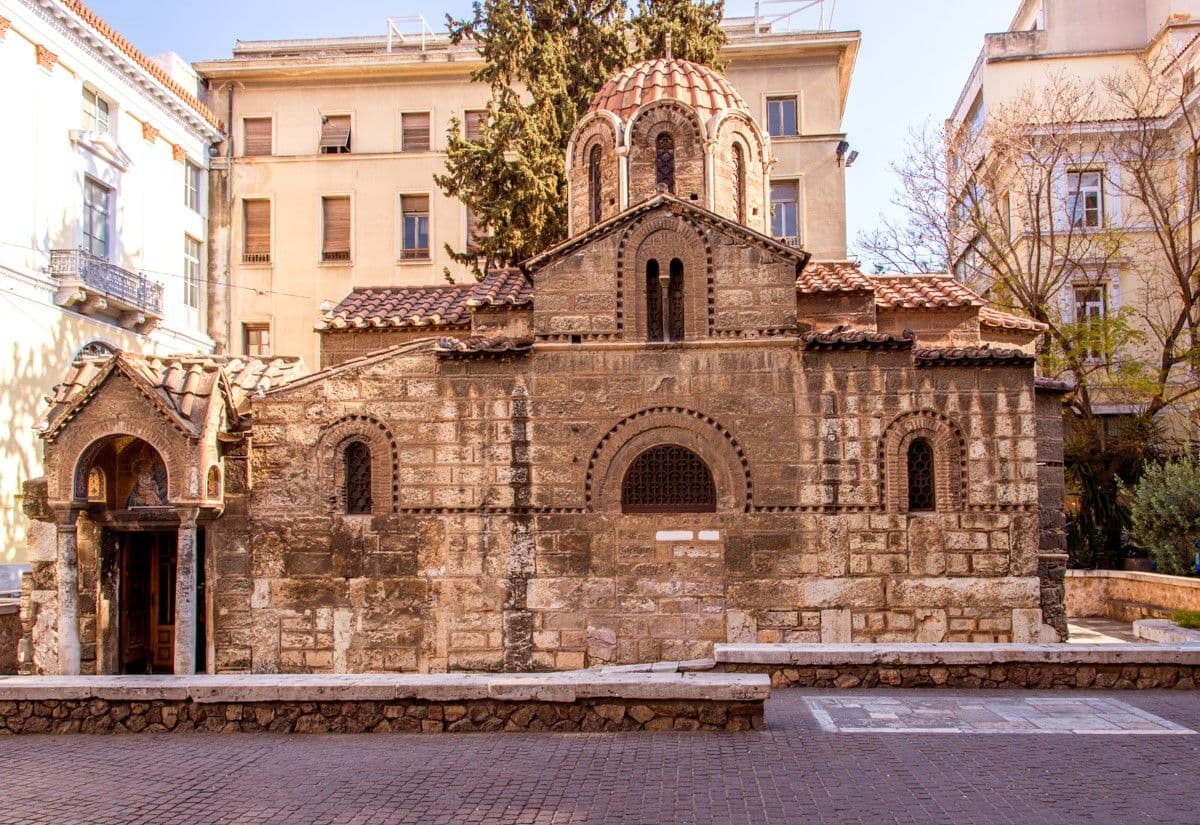
The Greek spirit of measure and harmony characterises the church of Kapnikarea. It adapts harmoniously to the human scale. Internally, it exudes a serene atmosphere, uplifting the faithful and bringing them into harmonious closeness with the Divine Presence.
Historical Context and Location
The sacred church of the Presentation of the Virgin (Kapnikarea) is located in the historic centre of Athens, on the commercial street of Ermou. It dates to the second half of the 11th century, the Middle Byzantine period, and is one of the most important Byzantine churches in Athens.
From the 9th century to 1204, the Byzantine Empire was at the height of its power. Especially during the period of the Macedonian and Komnenian dynasties, Byzantine classicism found its most ideal form.
In contrast to Constantinople, Athens was a small Byzantine town at the time of the construction of Kapnikarea, yet with the living memory of the ancient classical glory and brilliant past in the minds of the Byzantines.
The Name of the Church
There are different interpretations regarding the naming of the church as "Kapnikarea". The name "Kamoukharea" is also mentioned in older testimonies: the travellers Spon and Wheler in the last quarter of the 17th century refer to it by this epithet.
The prevailing interpretation is that the epithet "Kapnikarea" was given to the church by its founder, whose professional identity gave the name to the church. The founder, who was probably a "Kapnikaris", served as a collector of a type of poll tax called the "kapnikon" (hearth tax).
Architecture of the Church
The church in its current form consists of a complex of three building structures: the church of the Presentation of the Virgin, the chapel of St Barbara in the northern section, and the outer narthex with its entrance portico to the west.
The original building was constructed over the ruins of an ancient temple, following the custom of early Christians who built on pagan sites to establish Christianity.
The church of the Presentation of the Virgin architecturally belongs to the complex four-column type of cross-in-square with dome. This means that the cross formed in the roof of the church is inscribed in a square.
External Appearance
The masonry is formed of stone courses, some of which are material from early Christian buildings, a practice that was widely used in the Byzantine era. The courses at Kapnikarea are placed in such a way as to form crosses — characteristic of churches from the early 11th and 12th centuries.
In the upper sections the masonry follows the cloisonné system, which prevailed for a long time in the Greek-speaking world in church building from the second half of the 10th century. The roofing of the church has been done with stepped vaults, while all the roof terminations are emphasised at the bottom with dentil mouldings. At the centre, the elegant Athenian dome dominates.
The Dome — External Characteristics
The dome of Kapnikarea is of the Athenian type; the drum is octagonal, "with marble semi-octagonal section colonnettes at its edges". At eight points the rainwater converges; there are slender gargoyles in the form of animals — specifically lion heads, with prominent eyes and inset pupils. Four of them survive today.
Interior Layout
Interesting is the layout of the sanctuary, in which semicircular niches have been opened, with passages to the side chapels (paravimata). In this way the sanctuary acquires a tripartite form and movement within it is facilitated.
The dome of the church is supported internally by four unfluted columns, topped with early Christian capitals probably from the 5th century. Three of them are Corinthian, while the fourth is of Corinthianising type with recurved reed leaves above and acanthus leaves below.
Wall Paintings — Pictorial Decoration
Byzantine frescoes have not survived in the interior of the church of Kapnikarea. The icons that adorn the church today were made in the 1940s. The largest part belongs to Fotis Kontoglou, who began to paint the church in 1942, starting from the apse using the fresco technique.
It is evident from the icons of the sanctuary, dome and southern wall that he sought to give the monument a strict, calm and classicising post-Byzantine style, consistent with the early post-Byzantine era. The general aesthetic result of the sanctuary icons is characterised by a monumental style and a devotional feeling, arising from chromatic simplicity and harmony.
The Portico and Outer Narthex
The entrance portico is decorated with dentil mouldings and pediments are formed on all three sides. It dates to the early 12th century, with three brick arches, one of which, horseshoe-shaped, is harmonised with that of the walled-up door.
On the western side of the church, along its entire length, a narrow open arcade was added later, probably in the early 12th century, with two-lobed or single-lobed openings and unfluted columns. It is built with a particularly carefully executed cloisonné system.
The Church in the Modern Era
In 1834 the church was threatened with demolition by a decree of the Greek state in order to implement the urban plan of architect Leon von Klenze, who had planned to build Ermou Street straight and without obstacles in line with the entrance to the royal palace. Fortunately it was saved thanks to the intervention of Otto's father, King Ludwig of Bavaria, who was a philhellene.
The church of Kapnikarea today belongs to the University of Athens following the efforts of Professor Amilkas Alivizatos and in accordance with law, since 1931. Several restoration works have been carried out in the past, but it requires continuous maintenance and consolidation.
Interested in our educational activities?
Contact us to find out more about our programmes and visits.
Contact usOur activities are educational and non-profit, and should under no circumstances be confused with a guided tour by a professional. Our collaborators are volunteers, and participants may, if they wish, support us financially. The sources of the photographic material on the site are credited. If any photograph is your intellectual property, please let us know so that we can credit the source or remove it.