
21 October 2024
The Byzantine Period of Athens: From Constantine the Great to the Ottoman Conquest
From Roman Paganism to Christianity
Athens, from the end of the 3rd century AD, began to enter the Byzantine period, an era in which Christianity became dominant. A significant starting point of this transformation was the reign of Constantine the Great (306–337 AD), who with the Edict of Milan in 313 AD legalised Christianity and signalled the beginning of the gradual conversion of the ancient cities of the Roman world into Christian centres. In Athens, which until then had been a beacon of paganism and pagan traditions, the construction of the first Christian churches began and the religious identity of the city was gradually transformed.
However, this change was not immediate. During the reign of Julian the Apostate (361–363 AD), who attempted to revive paganism, Athens found itself at the centre of these efforts, given its reputation as a centre of ancient philosophy and ethnic religions. The actions of the Christian hierarchs of the era, such as Leonidas, Bishop of Athens, were decisive in overcoming these resistances.
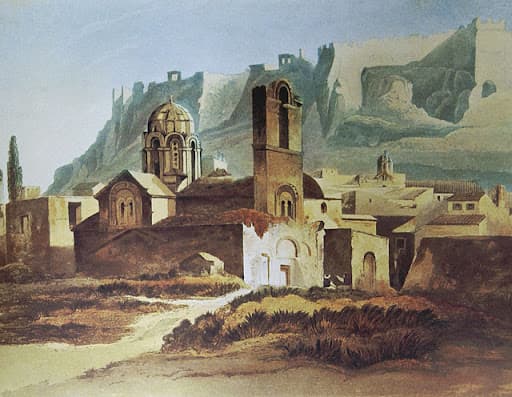
The introduction of Christianity to the city left its first marks on its buildings and churches. One of the first Byzantine churches was the Great Panagia at Hadrian's Library, built in the 5th century, which served as a centre of Christian worship in the city for centuries.
The Athenian Empresses
A particular aspect of Byzantine Athens is the women who were born in the city and became Byzantine empresses. Among them stands out Athenais (Augusta Eudocia), wife of Emperor Theodosius II. Athenais, daughter of an Athenian philosopher, was baptised a Christian and, as Eudocia, became a significant figure at the Court, known for her love of learning and piety. Other important empresses who originated from Athens include Irene the Athenian, who reigned as empress in the 8th century and played a decisive role in shaping Byzantine policy, especially during the Iconoclasm.
The Vow of the Bulgar-Slayer at the Panagia of the Acropolis
During the Byzantine era, the Virgin Mary held a special place in the religious conscience of Athenians. The Panagia of the Acropolis was one of the most revered icons in the city, and it is said that Emperor Basil II Bulgaroktonos offered a vow to the Panagia of the Acropolis for his victory over the Bulgars. The specific icon of the Virgin was associated with the safety of the city and the triumph of Byzantium over its enemies.
The Churches of the 11th Century
In the 11th century, Athens was revived as a religious and cultural centre, with the construction of numerous small churches, which are notable for their architecture. A characteristic example is Saint Eleftherios next to the Metropolis, as well as the Kapnikarea, which survives to this day. These churches are typically small and cross-shaped with a dome, showing the evolution of Byzantine ecclesiastical architecture.
These churches, however, suffered serious damage and many were demolished during the reign of Otto in the 19th century. Otto's efforts to modernise the city according to European standards, as well as the need to rebuild the central areas, led to the demolition of several Byzantine monuments.
Rangavis and the Relationship of the Palaiologoi with Athens
Michael I Rangavis, a lesser-known figure, was Emperor of the Byzantine Empire in the 9th century. He came from Athens and although his reign was brief, his origins connect the city to the central Byzantine political scene.
During the late Byzantine period, the Palaiologos family, which ascended to the throne in 1261, maintained close ties with Athens. The Palaiologoi sought to strengthen their dominance over the region of southern Greece, which retained strategic importance as a border with the Frankish principalities created after the fall of Constantinople in 1204. The Palaiologoi saw Athens as part of their cultural and intellectual heritage, a fact reflected in the works of the era.
The Catholic and Ottoman Period
After the conquest of Constantinople by the Crusaders in 1204, Athens came under Frankish rule, inaugurating the Catholic period. During this period, the Acropolis was converted into a Catholic cathedral dedicated to the Virgin Mary, and many Byzantine monuments were altered. In 1458, the city fell into the hands of the Ottomans, who maintained the city as a strategic fortress.
The fall of Athens under Ottoman rule marked the end of a long journey that began with the rise of Christianity, passing through the influences of Byzantium and the Frankish world. In the Byzantine era, Athens lost its political significance but maintained a spiritual and religious presence that shaped its medieval character.
Interested in our educational activities?
Contact us to find out more about our programmes and visits.
Contact usOur activities are educational and non-profit, and should under no circumstances be confused with a guided tour by a professional. Our collaborators are volunteers, and participants may, if they wish, support us financially. The sources of the photographic material on the site are credited. If any photograph is your intellectual property, please let us know so that we can credit the source or remove it.